
Underwater Navigation and Localisation without GPS Course
Learn to solve vehicle localisation underwater, where GPS does not reach: inertial navigation, acoustic positioning, Kalman filters and SLAM. A private online professional programme with a Navalis Institute certificate.
Prior knowledge check
These are the skills this programme gives you. Tick the ones you already master and we will tell you which part of the syllabus is for you.
You are starting from scratch in this subject. The programme is designed precisely for that.
What is the Underwater Navigation and Localisation without GPS Course?
This course prepares you to tackle one of the great challenges of marine robotics: knowing where a vehicle is underwater, where GPS signals cannot reach. You will study inertial navigation and dead reckoning with DVL, LBL and USBL acoustic positioning systems, sensor fusion with Kalman filters, underwater SLAM and seabed map-based navigation, with practical examples and simulation.
It stands out for its applied approach: you will work with real sensors, public datasets from underwater vehicles and simulation, and finish the programme by designing the navigation of a vehicle for a specific mission. It is a private online professional programme from Navalis Institute, with a private certificate from the institute.
Programme highlights
- Key problem: Localisation determines the success of any underwater mission.
- Real sensors: INS, DVL, depth sensors, compasses and acoustic systems.
- Sensor fusion: Kalman filters explained through examples.
- Advanced techniques: SLAM and terrain-based navigation.
- Practical case: Designing the navigation of an underwater vehicle.
- Boost your career: Apply what you learn in robotics, offshore and oceanography companies.
Syllabus of the Underwater Navigation and Localisation without GPS Course
5 modules. Select a module to see its content.
The Underwater Navigation Problem
- 1.1. Signal attenuation in water
- 1.2. Reference frames and coordinates
- 1.3. Sources of navigation error
- 1.4. Requirements by mission type
- 1.5. Overview of solutions
Inertial Navigation and Dead Reckoning
- 2.1. Inertial sensors
- 2.2. Dead reckoning
- 2.3. Doppler velocity log (DVL)
- 2.4. Depth sensors and compasses
- 2.5. Drift and error growth
Acoustic Positioning
- 3.1. Sound propagation in water
- 3.2. Long baseline systems
- 3.3. Ultra-short baseline systems
- 3.4. Navigation with surface beacons
- 3.5. Calibration and error sources
Sensor Fusion and Filtering
- 4.1. Estimation fundamentals
- 4.2. Kalman filter
- 4.3. Extended Kalman filter
- 4.4. Integration of asynchronous sensors
- 4.5. Performance evaluation
SLAM and Terrain-Based Navigation
- 5.1. Navigation with bathymetric maps
- 5.2. Sonar SLAM
- 5.3. Visual SLAM in clear waters
- 5.4. Cooperative navigation
- 5.5. Case study: designing a vehicle's navigation
Duration and format of the Underwater Navigation and Localisation without GPS Course
It is 300 hours. Tell us how many you can study each week and we will tell you when you will really finish.
This is the pace at which most students finish. It fits well with the instalment plan.
Academic leadership and faculty
The Navalis teaching team: working professionals who teach and supervise the programmes.
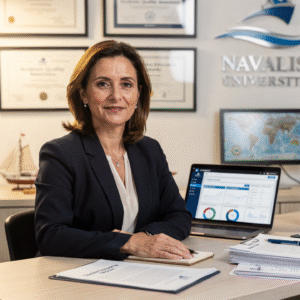 Dra. Marina AlcoverAcademic Director and Head of Quality Assurance
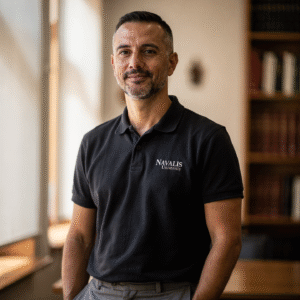 Ing. Diego CifuentesSenior Lecturer in Naval Welding and Non-Destructive Testing; Head of QA/QC for Welded Joints
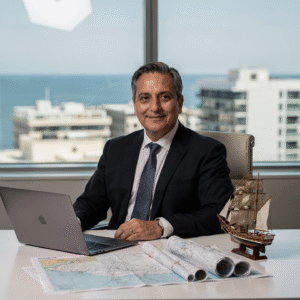 Cap. Javier Abaroa (MCA)Senior Lecturer in Ship Handling, Electronic Navigation (ECDIS/Radar/ARPA) and GMDSS; STCW Compliance and Bridge Resource Management Coordinator
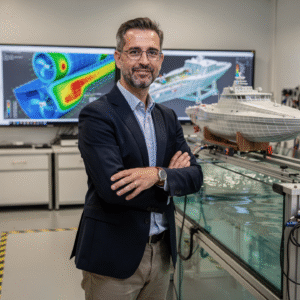 Dr. Pau FerrerSenior Lecturer in Naval Architecture and Simulation; Director of the Hydrodynamics and CFD Laboratory
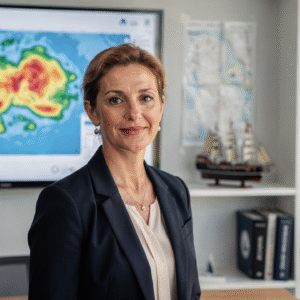 Dra. Nuria LlobregatSenior Lecturer in Marine Meteorology, SAR and Operational Safety; Navigation Risk Management Coordinator
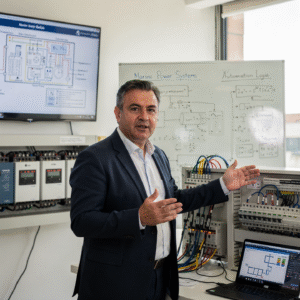 Ing. Javier BañulsSenior Lecturer in Electrical Engineering, Automation and ETO Engineering; Electronic Integration and Engine Alarms Coordinator
 Ing. Sofía MarquinaSenior Lecturer in Materials, Composites and Corrosion Protection; Coordinator of the Advanced Paints and Coatings Line
 Ing. Tomás RieraSenior Lecturer in Propulsion, Alternative Energy and Hybrid Systems; Energy Performance and Vibration Coordinator
Objectives of the Underwater Navigation and Localisation without GPS Course
Career opportunities after the Underwater Navigation and Localisation without GPS Course
Questions about the Underwater Navigation and Localisation without GPS Course
A programming background is recommended to follow the sensor fusion examples.
Only what is needed to understand the filters, explained step by step.
Yes. You work with public datasets from underwater vehicles and with simulation.
No. It is a specialisation programme with a private professional certificate from Navalis Institute and does not replace the sector's professional certifications.
You design the navigation system of an underwater vehicle for a specific mission.
100% online, with a virtual campus available 24/7, recorded live sessions and tutorials with the teaching staff.
The programme totals 300 hours. You can progress at your own pace within the calendar we give you when you enrol.
Each programme has its own start date, shown on this page and confirmed by the admissions team when you request information.
More programmes in Underwater robotics
Admission process
No waiting for a call back. If your documents are in order, you can enrol in the same session.
- Profile: university studies or professional experience in engineering, physics, robotics, hydrography or offshore operations.
- Language: sufficient command of the language of instruction to follow the classes and materials; basic technical English is recommended, as much of the sector's regulations and documentation is published in English.
- Technical resources: a computer with a stable internet connection, an up-to-date browser and a camera for the live sessions and project defences.
- Admission: online application, review of your profile and a short interview with the academic team.
- 01ApplicationYour details, background and documents.
- 02Instant reviewWe check that everything is complete and in order.
- 03EnrolmentChoose full payment or instalments and reserve your place.
Admission is provisional until the committee validates the documents provided. If you do not meet the requirements, the full amount is refunded.
Ask us before you enrol
Leave your details and admissions will write to you to answer any questions. If you are already sure, you can apply and pay in the same session.