
Professional Diploma in Underwater Robotics
This professional diploma immerses you in underwater exploration and work. You will learn to design, build and operate ROVs, from the frame and thrusters to the control system, and you will cover sensors, navigation and mission planning.
Prior knowledge check
These are the skills this programme gives you. Tick the ones you already master and we will tell you which part of the syllabus is for you.
You are starting from scratch in this subject. The programme is designed precisely for that.
What is the Professional Diploma in Underwater Robotics?
This professional diploma immerses you in underwater exploration and work. You will learn to design, build and operate ROVs (remotely operated vehicles), which are used to inspect, repair and maintain subsea infrastructure, and you will prepare for a growing job market.
The programme covers the electronics, hydraulics and control needed to create efficient and reliable underwater robots. It combines theory and practice through real projects and simulations, oriented towards the offshore, scientific and defence industries.
The programme stands out in five areas: design and fabrication of custom ROVs, selecting suitable components and materials; electronics, programming and control of ROVs, including navigation systems and sensors; hydraulic systems for ROV manipulation and movement; safe and efficient ROV operation, with preventive and corrective maintenance; and practical applications in real inspection, repair and maintenance projects on subsea structures.
Programme highlights
- Master underwater robotics: design, build and operate ROVs for exploration and inspection.
- Electronics and control: the control systems, sensors and actuators essential to underwater robotics.
- Subsea hydraulics and mechanics: hydraulic systems and mechanical design adapted to marine environments.
- Underwater navigation and positioning: ROV navigation and positioning techniques using advanced technologies.
- Practical applications: simulations and real projects in subsea industry scenarios.
- Build your career in subsea exploration and maintenance.
Syllabus of the Professional Diploma in Underwater Robotics
8 modules. Select a module to see its content.
Fundamentals of Underwater Robotics and the Aquatic Physical Environment
- 1.1. Introduction to underwater vehicles: classification of ROVs (Remotely Operated Vehicles), AUVs (Autonomous Underwater Vehicles) and gliders
- 1.2. Physics of the underwater environment: hydrostatics, pressure, buoyancy (Archimedes' principle), centre of mass and centre of buoyancy
- 1.3. Marine hydrodynamics: drag, drag coefficient (Cd), added mass and lift on submerged bodies
- 1.4. Structural design and materials to withstand hyperbaric pressure: titanium, marine aluminium (6061-T6, 7075), acrylics and syntactic polymers
- 1.5. Sealing and watertightness: O-rings, mechanical seals, underwater penetrator connectors and watertight housings
- 1.6. Pressure compensation and oil-filled, pressure-compensated systems for electronics and motors
- 1.7. Ballast management, neutral buoyancy and static/dynamic stability (underwater GM)
- 1.8. History and current state of underwater robotics
Hardware Architecture, Electronics and Propulsion Systems
- 2.1. On-board electronic architecture: microcontrollers, embedded computers, communication buses (CAN bus, RS-485, Ethernet)
- 2.2. Underwater thrusters: brushless DC (BLDC) motors, magnetic couplings, propeller design and Kort nozzles
- 2.3. Thruster configuration and geometry: thrust vectors for mobility in 3, 4, 5 and 6 degrees of freedom (DOF)
- 2.4. Power electronics and submersible electronic speed controllers (ESC): heat dissipation and overcurrent protection
- 2.5. Power supply and energy storage systems: lithium-ion/LiFePO4 batteries, battery management (BMS) and umbilical power supply (HVDC)
- 2.6. Communication and power umbilicals: optical fibre, copper conductors, armouring and cable buoyancy
- 2.7. Payload integration: standardised power and data interfaces for external sensors
- 2.8. Design of watertight housings
Underwater Sensors, Instrumentation and Perception
- 3.1. Inertial navigation sensors: Inertial Measurement Units (IMU), fibre-optic gyroscopes (FOG) and electronic compasses
- 3.2. Depth and status sensors: piezoelectric pressure transducers, temperature sensors and water leak detectors
- 3.3. Underwater acoustics and navigation systems: Side-Scan Sonar (SSS), Multibeam Echo Sounders (MBES) and altimeters
- 3.4. DVL (Doppler Velocity Log): estimation of speed over ground and acoustic odometry for marine vehicles
- 3.5. Underwater vision systems: high-definition cameras, optical refraction correction in flat/dome ports and LED lighting
- 3.6. Image quality in turbid waters: optical filtering, colour restoration algorithms, underwater dehazing and stereo vision
- 3.7. Specialised inspection sensors: ultrasonic thickness gauges and cathodic protection (CP) potential probes
- 3.8. Sonar and cameras for underwater robots
Kinematics, Dynamics and Automatic Control of Underwater Vehicles
- 4.1. Coordinate transformations: local (BODY) and global (NED / Earth-Fixed) reference frames and Euler angles (Quaternion)
- 4.2. Forward and inverse kinematics applied to marine vehicles and underwater manipulator arms
- 4.3. Non-linear 6 DOF dynamic modelling (Fossen's equations) including hydrodynamic forces, thrust and damping
- 4.4. PID control algorithms for heading, depth-hold and station keeping
- 4.5. Advanced and robust control: Sliding Mode Control (SMC), Adaptive Control and Model Predictive Control (MPC)
- 4.6. Thrust allocation: motor configuration matrix and conversion of forces/moments into ESC signals
- 4.7. Dynamic-hydrodynamic simulation in virtual environments (Gazebo, UWSim, Webots, ROS/ROS2)
- 4.8. Hydrodynamic modelling of vehicles
Underwater Navigation, Localisation and Mapping (SLAM)
- 5.1. Positioning acoustics: LBL (Long Baseline), SBL (Short Baseline) and USBL (Ultra-Short Baseline) systems
- 5.2. Navigation integration using Extended (EKF) and Unscented (UKF) Kalman Filters: IMU + DVL + USBL + pressure data fusion
- 5.3. Underwater simultaneous localisation and mapping (Underwater SLAM): visual SLAM (vSLAM) and acoustic sonar SLAM
- 5.4. Underwater 3D photogrammetric reconstruction and point cloud generation for submerged structures
- 5.5. Path planning algorithms: A*, RRT, potential fields for 3D obstacle avoidance
- 5.6. Underwater communication challenges: acoustic modems, short-range optical communications and marine sensor networks
- 5.7. Autonomous control of AUVs on long-endurance missions and management of signal loss/emergencies
- 5.8. DVL-aided navigation
Intervention, Underwater Manipulation and Collaborative Robotics
- 6.1. Underwater manipulator arms: classification (electric vs. hydraulic), degrees of freedom and reach
- 6.2. Intervention tools: cable cutters, cleaning brushes, samplers, jet guns and torque tools (valve turning)
- 6.3. Floating intervention (unsteady/floating-base manipulation): dynamic coupling between the ROV/AUV and the robotic arm
- 6.4. Teleoperation and haptics: master-slave interfaces, force feedback and augmented reality for ROV operators
- 6.5. Coordinated multi-robot operations: AUV swarms (swarm robotics) for large-scale mapping and oceanographic monitoring
- 6.6. Soft robotics applied to the collection of fragile biological samples and adaptive underwater grasping
- 6.7. Maintenance and repair of hydraulic manipulators: servo valves, miniature pumps and marinised eco-friendly fluids
- 6.8. Manipulators and end effectors
Industrial, Scientific and Military Applications
- 7.1. Inspection, Maintenance and Repair (IMR) in the offshore industry: oil platforms, gas fields and pipelines
- 7.2. Robotics for marine renewable energy: inspection of offshore wind farm foundations and tidal turbines
- 7.3. Underwater archaeology and biological/geological oceanography: exploration of abyssal trenches and hydrothermal vents
- 7.4. Civil infrastructure inspection: dams, flooded tunnels, subsea outfalls and ship hulls (hull inspection)
- 7.5. Defence and security operations: mine countermeasures (MCM), threat detection, harbour patrol and military salvage
- 7.6. Interface with unmanned surface vehicles (USV): combined USV-ROV/AUV operations for deployment and data gateway
- 7.7. Certification of robotic operations according to international standards (IMCA, DNV, ABS) and industrial safety audits
- 7.8. Applications in marine energy
Robotic Software Development, Artificial Intelligence and Capstone Project
- 8.1. Software architecture in underwater robotics: integration with Robot Operating System (ROS / ROS2) and MOOS-IvP
- 8.2. Real-time data processing and computer vision using OpenCV, PyTorch and CUDA in edge computing (Edge AI)
- 8.3. Artificial intelligence applied to marine robotics: autonomous detection of pipeline defects, fauna classification and target tracking
- 8.4. In-mission fault diagnosis (FDIR – Fault Detection, Isolation and Recovery) and return-to-surface safety systems (failsafe)
- 8.5. Robotics engineering project management: budget (CAPEX/OPEX), supplier selection, test tank trials and sea trials
- 8.6. Preventive maintenance, pre-deployment checklist and operational safety protocols during launch and recovery manoeuvres (LARS)
- 8.7. Presentation of the capstone project
- 8.8. Capstone project: comprehensive design, simulation in ROS/Gazebo, development of control/navigation algorithms and an operational test plan for an underwater vehicle (ROV or AUV) designed for a specific mission (pipeline inspection, scientific mapping or search and rescue)
Duration and format of the Professional Diploma in Underwater Robotics
It is 800 hours. Tell us how many you can study each week and we will tell you when you will really finish.
This is the pace at which most students finish. It fits well with the instalment plan.
Academic leadership and faculty
The Navalis teaching team: working professionals who teach and supervise the programmes.
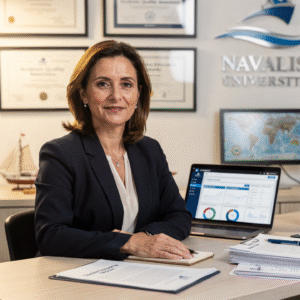 Dra. Marina AlcoverAcademic Director and Head of Quality Assurance
 Ing. Diego CifuentesSenior Lecturer in Naval Welding and Non-Destructive Testing; Head of QA/QC for Welded Joints
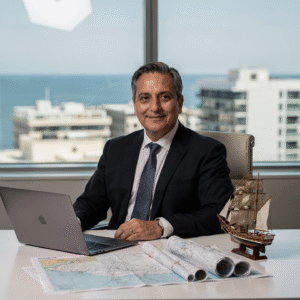 Cap. Javier Abaroa (MCA)Senior Lecturer in Ship Handling, Electronic Navigation (ECDIS/Radar/ARPA) and GMDSS; STCW Compliance and Bridge Resource Management Coordinator
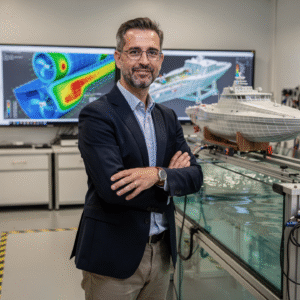 Dr. Pau FerrerSenior Lecturer in Naval Architecture and Simulation; Director of the Hydrodynamics and CFD Laboratory
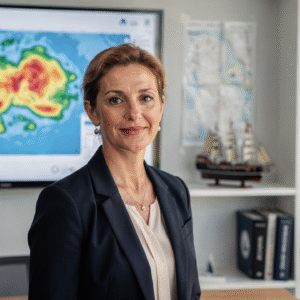 Dra. Nuria LlobregatSenior Lecturer in Marine Meteorology, SAR and Operational Safety; Navigation Risk Management Coordinator
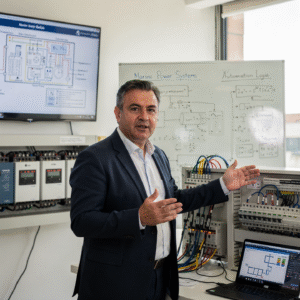 Ing. Javier BañulsSenior Lecturer in Electrical Engineering, Automation and ETO Engineering; Electronic Integration and Engine Alarms Coordinator
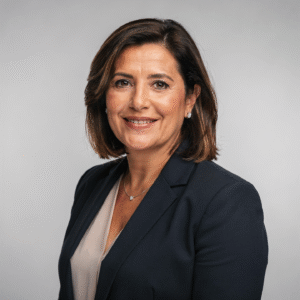 Ing. Sofía MarquinaSenior Lecturer in Materials, Composites and Corrosion Protection; Coordinator of the Advanced Paints and Coatings Line
 Ing. Tomás RieraSenior Lecturer in Propulsion, Alternative Energy and Hybrid Systems; Energy Performance and Vibration Coordinator
Objectives of the Professional Diploma in Underwater Robotics
Career opportunities after the Professional Diploma in Underwater Robotics
Questions about the Professional Diploma in Underwater Robotics
Underwater environments, including oceans, seas, lakes and rivers.
Yes. The pathway includes ECDIS/Radar-ARPA/BRM with port, ocean, fog, heavy-weather and SAR scenarios.
Online with live sessions; hybrid option for simulator stays/placements through partnership agreements.
Remotely operated vehicles (ROVs), autonomous underwater vehicles (AUVs) and, in some cases, hybrid robots.
Functional SMCP is recommended. We provide support materials for standard phraseology.
Yes, with a related qualification or experience in maritime/port operations. The admissions interview will confirm suitability.
Optional (3–6 months) through Companies & Partnerships and the Alumni Network.
Simulator exercises (rubrics), passage plans, SOPs, checklists, micro-tests and an applied master's thesis.
More programmes in Underwater robotics
Admission process
No waiting for a call back. If your documents are in order, you can enrol in the same session.
- Academic or professional profile: a higher vocational qualification in mechatronics, electronics, industrial automation or similar, or demonstrable professional experience with robotic equipment, preferably in aquatic environments.
- Technical knowledge: basic notions of electronics, hydraulics, pneumatics and programming (Python, with C++ desirable), and familiarity with underwater navigation and control systems.
- Physical aptitude: good general health and fitness for potentially demanding environments; a medical certificate may be required.
- Documentation: up-to-date CV, copy of your qualification or academic certificate, identity document or passport and a motivation letter.
- Technical requirements for the online part: a computer with high-speed internet, webcam, microphone and PDF reader. Enrolment is open all year round; admission is provisional until the committee validates your documentation.
- 01ApplicationYour details, background and documents.
- 02Instant reviewWe check that everything is complete and in order.
- 03EnrolmentChoose full payment or instalments and reserve your place.
Admission is provisional until the committee validates the documents provided. If you do not meet the requirements, the full amount is refunded.
Ask us before you enrol
Leave your details and admissions will write to you to answer any questions. If you are already sure, you can apply and pay in the same session.