
Master's in Underwater Robotics and Marine Drone Engineering
This master's programme gives you command of the construction, programming and operation of marine drones and underwater vehicles. You will work with electronics, control software, sensors and data transmission, finishing with mission planning and maintenance.
Prior knowledge check
These are the skills this programme gives you. Tick the ones you already master and we will tell you which part of the syllabus is for you.
You are starting from scratch in this subject. The programme is designed precisely for that.
What is the Master's in Underwater Robotics and Marine Drone Engineering?
Exploration and work in aquatic environments is a field in full evolution. This master's degree teaches you to build, program and operate ROVs (remotely operated vehicles) and marine drones, with applications in inspection, maintenance, research and rescue. It also develops skills in autonomous navigation, underwater image processing and the control of complex robotic systems.
Its ultimate aim is to prepare you to lead the next generation of marine robotics engineers.
Programme highlights
- Underwater robotics: design, construction and operation of robots for exploration and maintenance in the marine environment.
- Marine drones: specialisation in uncrewed aerial vehicles for maritime applications.
- Key technologies: computer vision, autonomous navigation, underwater communication and control systems.
- Hands-on practice: practical projects and simulations geared to the challenges of the sector.
- Career paths: offshore, marine research and infrastructure inspection, among others.
- Leadership in innovation: training to lead ocean exploration and management with advanced technologies.
Syllabus of the Master's in Underwater Robotics and Marine Drone Engineering
11 modules. Select a module to see its content.
Advanced autonomous navigation and adaptive control systems for underwater platforms and marine drones
- 1.1. Fundamentals of autonomous navigation: localisation principles, inertial sensors and event-based navigation
- 1.2. Mathematical models of underwater and aerial dynamics for marine drones: equations of motion and applied fluid mechanics
- 1.3. Adaptive control system architecture: online identification, predictive control and self-tuning under variable conditions
- 1.4. Multi-modal sensor fusion: advanced integration of sonar, LIDAR, GNSS, IMU and camera data for precision in underwater and marine environments
- 1.5. Autonomous route planning and optimisation algorithms: heuristic search, reinforcement learning and stochastic optimisation-based control
- 1.6. Deep neural networks and machine learning to improve control and adaptation in unstructured and dynamic environments
- 1.7. Uncertainty management and robustness: statistical and probabilistic techniques to ensure safe navigation in the presence of noise and faults
- 1.8. Real-time navigation systems: distributed architectures, latency minimisation and underwater communication protocols
- 1.9. Attitude and depth control: design and simulation of advanced PID controllers, adaptive control and fuzzy-logic-based methods
- 1.10. Simulators and virtual test benches: development, experimental validation and benchmarking of navigation and control algorithms
Integration and Optimisation of Acoustic and Optical Sensors for Advanced Perception in Autonomous Underwater Vehicles
- 2.1. Physical fundamentals and theories of acoustic propagation in underwater media: absorption, reflection, refraction and scattering in complex marine environments
- 2.2. Types and characteristics of acoustic sensors: hydrophones, active and passive sonar, acoustic arrays, multibeam and 3D acoustic imaging systems
- 2.3. Optical principles in aquatic environments: light absorption, attenuation, scattering and turbidity effects on underwater optical transmission
- 2.4. Advanced optical sensor technologies: multispectral and hyperspectral cameras, underwater lidar, stereoscopic vision systems and underwater photogrammetry
- 2.5. Integration of acoustic and optical sensors: data fusion architectures to enhance situational awareness and accuracy in object detection and classification
- 2.6. Design of embedded systems for real-time acquisition and processing of acoustic and optical signals on board autonomous underwater vehicles (AUVs)
- 2.7. Modelling and simulation of combined sensors: development of digital environments to evaluate performance under different ocean conditions and operational scenarios
- 2.8. Acoustic signal processing algorithms: adaptive filtering, beamforming, correlation and advanced techniques for localising and tracking underwater sound sources
- 2.9. Underwater image and video processing: optical correction, noise removal, contrast enhancement and segmentation for automatic analysis of underwater scenes
- 2.10. Multisensor fusion: probabilistic frameworks, machine learning techniques and neural networks for robust integration of acoustic and optical data
Autonomous Navigation, Adaptive Control and Advanced Sensory Perception Systems for Underwater Platforms and Marine Drones
- 3.1. Fundamentals of autonomous navigation: principles of dynamic localisation and inertial estimation in underwater environments
- 3.2. Design and architecture of adaptive control systems for unmanned marine vehicles: modelling, identification and real-time parameter estimation
- 3.3. Advanced multimodal sensory perception algorithms: integration of multibeam sonar, underwater LIDAR and optical systems for environmental mapping and obstacle detection
- 3.4. Filters and data fusion techniques: implementation of extended Kalman filters (EKF), particle filters and machine learning methods to improve navigation accuracy
- 3.5. Robust optimisation of adaptive control: predictive control and model-based control strategies to handle uncertainties and dynamic disturbances in the marine environment
- 3.6. Embedded system architectures for real-time processing: selection of microcontrollers, FPGAs and DSPs for energy-constrained underwater platforms and marine drones
- 3.7. Deep neural networks and reinforcement learning applied to automated decision-making: design, training and validation in simulators and real environments
- 3.8. Advanced underwater and coastal navigation techniques: inertial navigation, use of acoustic positioning systems (LBL, SBL, USBL) and GNSS at the surface
- 3.9. Underwater communication protocols for data reception and transmission: acoustic modulation, error-correction techniques and underwater ad hoc networks
- 3.10. Safety and resilience in autonomous systems: early fault detection, functional redundancy and recovery mechanisms to ensure continuous operation
Hybrid propulsion, energy management and underwater communications for subsea vehicles: design, simulation and certification of ROVs and marine drones
- 4.1. Fundamentals of hybrid propulsion for subsea vehicles: thermodynamic principles, electric and internal combustion engines, mechanical and electrical integration.
- 4.2. Design and optimisation of combined propulsion systems: component selection, performance analysis, power balance and energy efficiency.
- 4.3. Advanced on-board energy management: storage with high-density batteries, supercapacitors, fuel cells and recharging systems in the marine environment.
- 4.4. Dynamic modelling and simulation of energy behaviour in ROVs and marine drones: specialised software, integration of environmental and operational variables.
- 4.5. Underwater communication protocols: acoustic, optical and electromagnetic; comparison of technologies, range, latency and bandwidth.
- 4.6. Design of communication networks for coordinated operations: network topologies, routing, redundancy and cybersecurity in hostile environments.
- 4.7. International regulations and standards for the certification of subsea vehicles: classification, laboratory tests and trials under real conditions.
- 4.8. Modular and scalable design methodologies for energy and propulsion systems to facilitate maintenance, upgrading and industrial replicability.
- 4.9. Sensor integration for real-time monitoring of critical parameters: energy flow, fault diagnosis, overload prevention and thermal management.
- 4.10. Advanced case studies: comparative analysis of hybrid systems applied in scientific, military and commercial missions, with efficiency and endurance results.
Design and Development of Autonomous Hybrid Systems for Exploration, Inspection and Maintenance in Complex Underwater Environments
- 5.1. Advanced fundamentals of hybrid system design: mechanical, electronic and software integration for underwater applications
- 5.2. Autonomous control architectures: modelling, decision-making algorithms and navigation systems in dynamic and unstructured environments
- 5.3. Design and selection of specialised sensors and actuators: multibeam sonar, underwater LIDAR, hyperspectral cameras and integrated inertial systems (IMU, DVL)
- 5.4. Development of robust, real-time communication protocols for hybrid vehicles under conditions of high attenuation and underwater acoustic noise
- 5.5. Energy optimisation and battery management: storage technologies, consumption efficiency and energy recovery for prolonged operations
- 5.6. Numerical modelling and simulation of the dynamics and behaviour of hybrid systems: CFD simulations and fluid–structure interaction analysis
- 5.7. Implementation of advanced artificial intelligence and machine learning algorithms for pattern recognition, real-time mapping and adaptation to changing environments
- 5.8. Integrated mission planning strategies: from exploration to inspection and predictive maintenance of complex subsea infrastructure
- 5.9. Safety and redundancy protocols: design of fault-tolerant critical systems and autonomous recovery mechanisms in adverse scenarios
- 5.10. Case study: design of an automated hybrid system for subsea pipeline inspection with structural analysis and anomaly detection tools
Advanced Autonomous Navigation, Sensory Perception and Energy Management Systems for Underwater Platforms and Marine Drones
- 6.1. Fundamentals of autonomous navigation: kinematics and dynamics of underwater platforms and marine drones, advanced mathematical modelling and predictive control.
- 6.2. Simultaneous localisation and mapping (SLAM) algorithms: integration of multi-modal sensors for dynamic, real-time construction of underwater maps.
- 6.3. Advanced sensory perception: use and calibration of multibeam sonar systems, underwater LIDAR, hyperspectral cameras and IMU inertial sensors for data fusion.
- 6.4. Sensor fusion and signal processing: machine learning techniques to improve detection, object classification and noise mitigation in complex environments.
- 6.5. Acoustic positioning systems (USBL, LBL, SBL) and their integration with GNSS on surface drones to ensure accuracy in deep autonomous manoeuvres.
- 6.6. Acoustic propagation models in underwater environments: analysis of attenuation, refraction and multipath effects to optimise communications and positioning.
- 6.7. Advanced energy management: design and optimisation of hybrid power systems (high-density batteries, fuel cells and marine renewable energy) for extended autonomy on prolonged missions.
- 6.8. Intelligent energy management strategies: adaptive algorithms for real-time monitoring, load distribution and service-life extension on unmanned platforms.
- 6.9. Implementation of redundant control systems and energy safety protocols to minimise critical failures in deep underwater operations.
- 6.10. Simulation and evaluation in digital environments: use of digital twins for behaviour prediction, trajectory optimisation and validation of autonomous systems under variable conditions.
Integrated Autonomous Navigation, Advanced Sensory Perception and Energy Management Systems for Underwater Platforms and Marine Drones
- 7.1. Fundamentals of autonomous navigation: design principles and control algorithms for autonomous systems in underwater and marine environments, including kinematic and dynamic models applied to unmanned vehicles.
- 7.2. Integrated navigation architecture and sensors: detailed study of inertial sensors (IMU), marine GNSS systems, Doppler sensors (DVL), multibeam sonar and acoustic sensors for real-time data fusion and precise positioning.
- 7.3. Advanced estimation filters: theory and practical application of extended Kalman filters (EKF), particle filters and SLAM (Simultaneous Localization and Mapping) algorithms to improve perception and navigation in dynamic and structurally complex environments.
- 7.4. Advanced sensory perception: integration and processing of data from optical (LIDAR, underwater cameras), acoustic and magnetic sensors for three-dimensional reconstruction of the environment and real-time detection of obstacles and targets.
- 7.5. Signal processing algorithms: advanced filtering techniques, spectral analysis, pattern recognition and machine learning applied to sensory interpretation and autonomous decision-making on underwater platforms and marine drones.
- 7.6. Integrated energy management: design and optimisation of hybrid power systems (lithium batteries, fuel cells, marine renewable energy) with intelligent consumption and recharging strategies to extend the vehicles' operational endurance.
- 7.7. Energy control systems and smart batteries: real-time monitoring, load balancing, predictive diagnostics and safety protocols to maximise service life and energy efficiency on underwater and marine aerial platforms.
- 7.8. Underwater and aerial communication and telemetry: technologies for data transmission in challenging physical environments, including underwater acoustics, marine radio frequency and adaptive communication protocols to ensure integrity and low latency.
- 7.9. Integration of navigation and energy systems with a modular architecture: development of modular platforms enabling scalability, simplified maintenance and continuous technological upgrading without loss of operational functionality in the field.
- 7.10. Simulation and field testing: use of advanced simulated environments and test benches to validate autonomous navigation, multisensor perception and energy management systems under varied operating conditions and environmental stress.
Innovation in Modular Architectures and Intelligent Design of Autonomous Underwater Vehicles and Hybrid Marine Drones
- 8.1. Fundamentals of modular architectures: theory, benefits and standards applied to underwater systems and hybrid marine drones
- 8.2. Intelligent design for autonomy: integration of AI for adaptive decision-making and learning in dynamic marine environments
- 8.3. Advanced materials and their impact on modularity: composites, lightweight alloys and antifouling coatings for submersible vehicles
- 8.4. Inter-module communication interfaces: CAN protocols, industrial Ethernet and underwater acoustic communication systems
- 8.5. Distributed energy architectures: solid-state batteries, modular storage and intelligent energy management in hybrid vehicles
- 8.6. Modular propulsion and hybrid systems: design, optimisation and adaptive control of electric motors and hydraulic thrusters
- 8.7. Integrated sensing and data fusion: modular configuration of acoustic, optical, chemical and magnetometric sensors for advanced navigation and mapping
- 8.8. Functional redundancy and fault tolerance in modular systems: advanced diagnostic, recovery and predictive maintenance techniques
- 8.9. Digital simulation and modelling of modular architectures: CAD/CAE tools, digital twins and performance analysis under real underwater conditions
- 8.10. Implementation of underwater IoT communication protocols for real-time control, telemetry and cybersecurity in hybrid autonomous vehicles
Advanced Navigation, Sensory Perception and Energy Management Systems for Autonomous Vehicles in Underwater Environments
- 9.1. Fundamentals of underwater navigation: physical principles and specific challenges in deep and variable aquatic environments
- 9.2. Acoustic positioning systems: mechanisms, accuracy and calibration of LBL (Long Baseline), SBL (Short Baseline) and USBL (Ultra Short Baseline)
- 9.3. Multi-sensor integration for autonomous navigation: fusion of IMU, DVL (Doppler Velocity Log), pressure sensor and sonar data
- 9.4. Advanced sensory perception: multibeam sonar technologies, underwater photogrammetric cameras and lidars adapted for subsea vehicles
- 9.5. Real-time processing of acoustic and optical signals for detection, classification and mapping of obstacles in turbid environments
- 9.6. Autonomous navigation and control algorithms: implementation of extended Kalman filters, SLAM (Simultaneous Localization and Mapping) and machine-learning-based navigation
- 9.7. Optimised energy management for marine vehicles: renewable energy storage and generation systems adapted to underwater platforms and marine drones
- 9.8. Power management systems: real-time monitoring, load balancing and mitigation strategies for faults or adverse environmental conditions
- 9.9. Design and configuration of robust electronic architectures to ensure continuous and redundant operation under the pressure and corrosion of the underwater environment
- 9.10. Underwater communication protocols: acoustic and optical technologies for high-speed, low-latency data transmission
Manufacturing, testing and validation of underwater vehicles and marine drones
- 10.1. Rapid prototyping and additive manufacturing of components
- 10.2. Watertightness and pressure tests
- 10.3. Tank and pool tests
- 10.4. Open-sea field trials
- 10.5. Validation of navigation systems
- 10.6. Energy endurance tests
- 10.7. Hardware-in-the-loop and simulation
- 10.8. Failure and reliability analysis
- 10.9. Certification and regulations for marine drones
- 10.10. Vehicle technical documentation
Master's Thesis: Integrated Design and Certification of Autonomous Underwater Systems for Exploration and Maintenance in Deep-Water Environments
- 11.1. Definition and scope of the final project: objectives, technical specifications and regulatory requirements applicable to autonomous underwater systems in deep-water environments
- 11.2. Conceptual design and architecture of autonomous underwater robotic systems: selection and sizing of sensors, actuators, propulsion systems and high-pressure-resistant structures
- 11.3. Advanced control systems engineering: design of autonomous navigation, localisation and mapping (SLAM) algorithms in complex aquatic media, and adaptive control in response to environmental variability
- 11.4. Integration of underwater communication systems: acoustic, optical and electromagnetic technologies for real-time data transmission and remote control
- 11.5. Dynamic simulation and modelling of underwater vehicles: numerical and physical evaluation of hydrodynamic and energy behaviour to optimise performance and endurance
- 11.6. Development of safety and redundancy protocols: risk analysis, fault tolerance, automatic recovery strategies and certification in compliance with international standards (ISO, IEC)
- 11.7. Implementation of artificial intelligence and machine learning systems for autonomous decision-making in the inspection, exploration and maintenance of subsea infrastructure
- 11.8. Advanced non-destructive testing (NDT) methodologies using autonomous marine drones: ultrasonic techniques, underwater LIDAR and machine vision
- 11.9. Planning and execution of operational campaigns in deep-ocean environments: logistics, risk analysis, deployment protocols and recovery of robotic units
- 11.10. Procedures for the certification and type approval of underwater robotic systems: technical criteria, laboratory and sea tests, performance validation and environmental compliance
Duration and format of the Master's in Underwater Robotics and Marine Drone Engineering
It is 1,500 hours. Tell us how many you can study each week and we will tell you when you will really finish.
This is the pace at which most students finish. It fits well with the instalment plan.
Academic leadership and faculty
The Navalis teaching team: working professionals who teach and supervise the programmes.
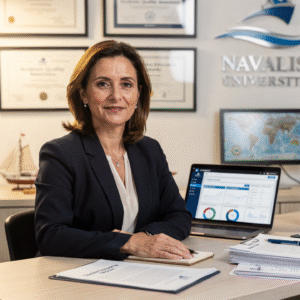 Dra. Marina AlcoverAcademic Director and Head of Quality Assurance
 Ing. Diego CifuentesSenior Lecturer in Naval Welding and Non-Destructive Testing; Head of QA/QC for Welded Joints
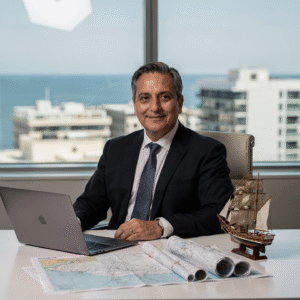 Cap. Javier Abaroa (MCA)Senior Lecturer in Ship Handling, Electronic Navigation (ECDIS/Radar/ARPA) and GMDSS; STCW Compliance and Bridge Resource Management Coordinator
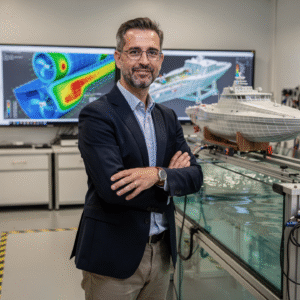 Dr. Pau FerrerSenior Lecturer in Naval Architecture and Simulation; Director of the Hydrodynamics and CFD Laboratory
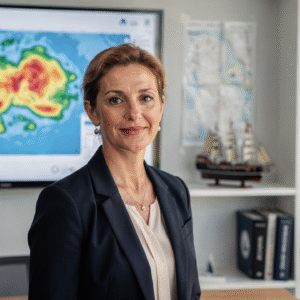 Dra. Nuria LlobregatSenior Lecturer in Marine Meteorology, SAR and Operational Safety; Navigation Risk Management Coordinator
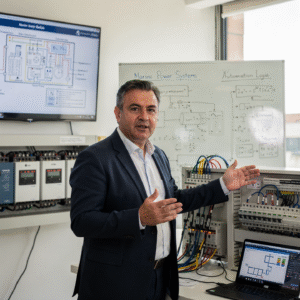 Ing. Javier BañulsSenior Lecturer in Electrical Engineering, Automation and ETO Engineering; Electronic Integration and Engine Alarms Coordinator
 Ing. Sofía MarquinaSenior Lecturer in Materials, Composites and Corrosion Protection; Coordinator of the Advanced Paints and Coatings Line
 Ing. Tomás RieraSenior Lecturer in Propulsion, Alternative Energy and Hybrid Systems; Energy Performance and Vibration Coordinator
Objectives of the Master's in Underwater Robotics and Marine Drone Engineering
Career opportunities after the Master's in Underwater Robotics and Marine Drone Engineering
Questions about the Master's in Underwater Robotics and Marine Drone Engineering
Aquatic.
Yes. The pathway includes ECDIS/Radar-ARPA/BRM with port, ocean, fog, heavy-weather and SAR scenarios.
Online with live sessions; hybrid option for simulator/work placement stays through partnership agreements.
Both.
Functional SMCP is recommended. We provide support materials for standard phraseology.
Yes, with a related qualification or experience in maritime/port operations. The admission interview will confirm your suitability.
Optional (3–6 months) through Companies & Partnerships and the Alumni Network.
Simulator exercises (rubrics), passage plans, SOPs, checklists, micro-tests and an applied master's thesis.
More programmes in Underwater robotics
Admission process
No waiting for a call back. If your documents are in order, you can enrol in the same session.
- Academic or professional profile: a degree in engineering (electronic, mechanical, computer, etc.), in science (physics, mathematics, etc.) or a related qualification. Demonstrable professional experience in robotics, marine engineering or drone operation is also accepted.
- Technical knowledge: solid skills in programming (Python and C++), embedded systems, automatic control, signal processing and communications. Experience in robotics, computer vision, sensors and actuators is valued.
- Language competence: advanced technical English (B2 or higher) to read technical documentation, take part in international projects and consult specialist literature.
- Documents: up-to-date CV, copies of qualifications, academic transcript, identity document or passport, and a motivation letter on your interest in the programme and your professional expectations.
- Technical requirements for online study: a computer with camera and microphone, a high-speed connection, up-to-date software and the capacity to run simulations and CAD tools.
- 01ApplicationYour details, background and documents.
- 02Instant reviewWe check that everything is complete and in order.
- 03EnrolmentChoose full payment or instalments and reserve your place.
Admission is provisional until the committee validates the documents provided. If you do not meet the requirements, the full amount is refunded.
Ask us before you enrol
Leave your details and admissions will write to you to answer any questions. If you are already sure, you can apply and pay in the same session.