
Master's in Remote Operation of Autonomous Ships and the MASS Code
This master's programme prepares you to work in the new generation of autonomous and remotely operated ships. You will work on shore control centres, sensor fusion, communications and failure management, and you will examine the IMO MASS Code and the open legal questions.
Prior knowledge check
These are the skills this programme gives you. Tick the ones you already master and we will tell you which part of the syllabus is for you.
You are starting from scratch in this subject. The programme is designed precisely for that.
What is the Master's in Remote Operation of Autonomous Ships and the MASS Code?
This master's degree prepares you to work with the new generation of autonomous and remotely operated ships. With the adoption of the IMO MASS Code, navigation with little or no crew is moving from experimentation to regulation. The programme explains how these ships perceive their surroundings, how they make decisions, how they are supervised from a remote control centre, how they are protected from cyberattacks and what the regulations require for safe operation.
What sets the programme apart: up-to-date regulation, with study of the MASS Code and its relationship to SOLAS, COLREG and STCW; the full technology stack, covering sensors, data fusion, artificial intelligence, communications and control; the remote control centre, including design, manning and shore-based operating procedures; integrated cybersecurity, protecting critical systems on connected ships; and a real project in which you design the concept of operations (ConOps) for an autonomous ship.
Programme highlights
- Understand autonomy: levels and architectures of MASS vessels.
- Master perception: radar, LiDAR, cameras, AIS and sensor fusion.
- Operate remotely: supervising ships from a remote control centre.
- Comply with regulation: applying the MASS Code and approval processes.
- Lead innovation: position yourself in a field with strong growth in the sector.
- Join the generation that will operate the autonomous ships already being built.
Syllabus of the Master's in Remote Operation of Autonomous Ships and the MASS Code
11 modules. Select a module to see its content.
Fundamentals of Autonomous Ships
- 1.1. Definition of a maritime autonomous surface ship (MASS)
- 1.2. Levels and modes of autonomy
- 1.3. History and evolution of autonomy projects
- 1.4. Autonomous ships in service and under construction
- 1.5. Benefits: safety, costs, efficiency and new tasks
- 1.6. Current technical and operational limitations
- 1.7. Candidate ship types and operations
- 1.8. Value chain and industry stakeholders
- 1.9. Impact on maritime professions
- 1.10. Adoption scenarios
Regulatory Framework: the MASS Code and IMO Instruments
- 2.1. IMO regulatory process on autonomy
- 2.2. Structure and scope of the MASS Code
- 2.3. Relationship with SOLAS, COLREG, STCW and MARPOL
- 2.4. Concept of operations (ConOps) and its approval
- 2.5. Role of the master and liability on remotely operated ships
- 2.6. Requirements for the remote control centre
- 2.7. Trials and testing in national waters
- 2.8. Insurance and civil liability
- 2.9. Classification society rules
- 2.10. Expected development of regulation
Sensors, Perception and Data Fusion
- 3.1. Marine radar and signal processing
- 3.2. LiDAR and its use in marine environments
- 3.3. Visible and infrared cameras
- 3.4. AIS, GNSS and inertial systems
- 3.5. Acoustic and meteorological sensors
- 3.6. Multi-sensor fusion and Kalman filters
- 3.7. Target detection and tracking
- 3.8. Adverse conditions: rain, fog and waves
- 3.9. Calibration and redundancy
- 3.10. Ship situational awareness
Artificial Intelligence for Navigation
- 4.1. Machine learning and computer vision
- 4.2. Classification of vessels and objects
- 4.3. Trajectory prediction of other ships
- 4.4. COLREG-compliant collision avoidance algorithms
- 4.5. Route planning and optimisation
- 4.6. Reinforcement learning and simulation
- 4.7. Validation and verification of AI systems
- 4.8. Explainability and operator trust
- 4.9. Data bias and limitations
- 4.10. Certification of AI software in safety-critical environments
Control, Manoeuvring and Onboard Systems
- 5.1. Control architecture of the autonomous ship
- 5.2. Advanced autopilot and track keeping
- 5.3. Autonomous berthing and unberthing
- 5.4. Electric propulsion and power control
- 5.5. Monitoring of unmanned machinery
- 5.6. Predictive maintenance and self-diagnosis
- 5.7. Fault management and degraded modes
- 5.8. Minimum risk manoeuvre
- 5.9. Integration with port systems
- 5.10. Sea trials of autonomous systems
Communications and Connectivity
- 6.1. Ship–shore communication requirements
- 6.2. Low Earth orbit and geostationary satellites and maritime 5G
- 6.3. Latency, bandwidth and availability
- 6.4. Redundancy and management of link loss
- 6.5. Transmission of video and sensor data
- 6.6. Communications with other ships and with VTS
- 6.7. E-navigation services and S-100
- 6.8. Prioritisation of critical data
- 6.9. Connectivity trials on real routes
- 6.10. Communication costs and sizing
Remote Control Centre: Design and Operation
- 7.1. Functions of the remote operation centre (ROC)
- 7.2. Workstation design and ergonomics
- 7.3. Manning, shifts and operator-to-ship ratio
- 7.4. Human–machine interfaces and alarm management
- 7.5. Takeover of control and handover between centres
- 7.6. Normal and emergency procedures
- 7.7. Fatigue, workload and situational awareness
- 7.8. Training and qualification of remote operators
- 7.9. Simulators for training
- 7.10. Centre performance indicators
Cybersecurity of Autonomous Ships
- 8.1. Attack surface of a connected ship
- 8.2. IMO guidelines on cyber risk management
- 8.3. IACS UR E26 and E27 requirements
- 8.4. Network segmentation and secure architecture
- 8.5. Protection of communication links
- 8.6. GNSS and AIS spoofing
- 8.7. Intrusion detection and incident response
- 8.8. Security in the software supply chain
- 8.9. Penetration testing and exercises
- 8.10. Recovery and continuity of operations
Risk Management, Safety and Human Factors
- 9.1. Risk analysis of autonomous systems
- 9.2. STPA, FMEA and fault tree analysis methods
- 9.3. Safety cases
- 9.4. Interaction with manned ships
- 9.5. Search and rescue with unmanned ships
- 9.6. Emergency response on board without crew
- 9.7. Human factors in remote supervision
- 9.8. Accountability and decision-making
- 9.9. Investigation of incidents involving autonomous systems
- 9.10. Acceptance by the maritime community
Business Models and Implementation
- 10.1. Use cases: short-sea shipping, ferries, harbour services and offshore
- 10.2. Autonomous surveillance, hydrographic and support vessels
- 10.3. Cost-benefit analysis of autonomy
- 10.4. Retrofitting of existing ships
- 10.5. Alliances between shipping companies, shipyards and technology firms
- 10.6. Change management in organisations
- 10.7. Relations with ports and authorities
- 10.8. Testing and scale-up plan
- 10.9. Financing of innovation projects
- 10.10. Autonomous ship market trends
Master's Final Project: Concept of Operations for an Autonomous Ship
- 11.1. Selection of the ship, route and operation
- 11.2. Definition of the level of autonomy
- 11.3. Sensor and system architecture
- 11.4. Design of connectivity and redundancy
- 11.5. Design of the remote control centre
- 11.6. Risk analysis and safety case
- 11.7. Cybersecurity plan
- 11.8. Compliance with the MASS Code and approval plan
- 11.9. Economic study and implementation plan
- 11.10. Writing of the report and defence before a panel
Duration and format of the Master's in Remote Operation of Autonomous Ships and the MASS Code
It is 1,500 hours. Tell us how many you can study each week and we will tell you when you will really finish.
This is the pace at which most students finish. It fits well with the instalment plan.
Academic leadership and faculty
The Navalis teaching team: working professionals who teach and supervise the programmes.
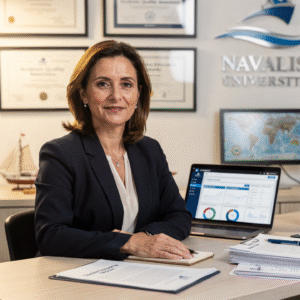 Dra. Marina AlcoverAcademic Director and Head of Quality Assurance
 Ing. Diego CifuentesSenior Lecturer in Naval Welding and Non-Destructive Testing; Head of QA/QC for Welded Joints
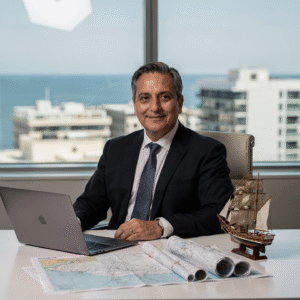 Cap. Javier Abaroa (MCA)Senior Lecturer in Ship Handling, Electronic Navigation (ECDIS/Radar/ARPA) and GMDSS; STCW Compliance and Bridge Resource Management Coordinator
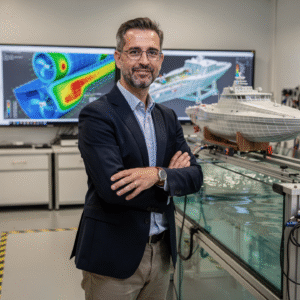 Dr. Pau FerrerSenior Lecturer in Naval Architecture and Simulation; Director of the Hydrodynamics and CFD Laboratory
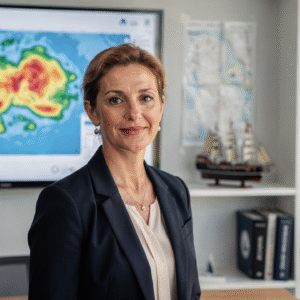 Dra. Nuria LlobregatSenior Lecturer in Marine Meteorology, SAR and Operational Safety; Navigation Risk Management Coordinator
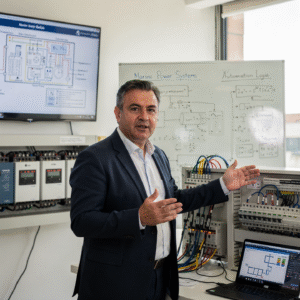 Ing. Javier BañulsSenior Lecturer in Electrical Engineering, Automation and ETO Engineering; Electronic Integration and Engine Alarms Coordinator
 Ing. Sofía MarquinaSenior Lecturer in Materials, Composites and Corrosion Protection; Coordinator of the Advanced Paints and Coatings Line
 Ing. Tomás RieraSenior Lecturer in Propulsion, Alternative Energy and Hybrid Systems; Energy Performance and Vibration Coordinator
Objectives of the Master's in Remote Operation of Autonomous Ships and the MASS Code
Career opportunities after the Master's in Remote Operation of Autonomous Ships and the MASS Code
Questions about the Master's in Remote Operation of Autonomous Ships and the MASS Code
It is the IMO code that regulates maritime autonomous surface ships. The master's programme studies it in detail, together with its relationship with SOLAS, COLREG and STCW.
It is not essential. The fundamentals of AI and systems are explained, although technical profiles will be able to go into greater depth.
Yes. Remote operation needs professionals with navigational experience, and the master's programme gives them the technological foundation.
Yes. Simulations of navigation, perception and operation from a remote control centre are used.
You design the complete concept of operations for an autonomous ship, ready to be submitted for approval.
100% online, with a virtual campus available 24/7, live sessions that are recorded, and tutorials with the teaching staff.
The programme has a workload of 1500 hours. You can progress at your own pace within the timetable we give you when you enrol.
Each programme has its own start date, which is shown on this page and confirmed by the admissions team when you request information.
More programmes in Bridge and navigation
Admission process
No waiting for a call back. If your documents are in order, you can enrol in the same session.
- Academic or professional profile: a degree in nautical science, naval engineering, electronics, telecommunications, computer science or robotics, or accredited experience as a deck officer or in maritime systems.
- Language: a sufficient command of the language of instruction to follow classes and materials. A basic level of technical English is recommended, since much of the sector's regulation and documentation is in English.
- Technical resources: a computer with a stable internet connection, an up-to-date browser and a camera for live sessions and project presentations.
- Admission process: online application, profile review and a short interview with the academic team.
- 01ApplicationYour details, background and documents.
- 02Instant reviewWe check that everything is complete and in order.
- 03EnrolmentChoose full payment or instalments and reserve your place.
Admission is provisional until the committee validates the documents provided. If you do not meet the requirements, the full amount is refunded.
Ask us before you enrol
Leave your details and admissions will write to you to answer any questions. If you are already sure, you can apply and pay in the same session.