
Master's in Underwater Robotics (ROVs and AUVs)
This master's programme gives you command of the design, operation and maintenance of unmanned underwater vehicles. You will work on propulsion, power supply, underwater navigation and payloads, finishing with mission planning and data analysis.
Prior knowledge check
These are the skills this programme gives you. Tick the ones you already master and we will tell you which part of the syllabus is for you.
You are starting from scratch in this subject. The programme is designed precisely for that.
What is the Master's in Underwater Robotics (ROVs and AUVs)?
This master's degree trains you to lead the next generation of ocean exploration. It covers the design, operation and maintenance of remotely operated vehicles (ROVs) and autonomous underwater vehicles (AUVs), which are key tools in scientific research, the offshore industry and the inspection of submerged infrastructure.
It is an intensive programme with a solid grounding in engineering, robotics and oceanography, with practice on advanced simulators and real equipment. You will learn to program, navigate and solve problems in complex underwater environments, with the aim of driving innovation in a growing sector.
What sets this master's degree apart: real projects, designing, building and operating ROVs and AUVs in simulated and real missions; current software and hardware, with training in the tools and technologies in use on the market today; and professional contacts within the underwater robotics sector.
Programme highlights
- Design and operation: master the construction, piloting and maintenance of ROVs and AUVs, the basic tools of underwater exploration.
- Advanced technologies: go in depth into autonomous navigation, underwater image processing and artificial intelligence applied to marine robotics.
- Practical applications: the use of underwater robotics in infrastructure inspection, scientific research, maritime rescue and the offshore industry.
- Simulations and practical work: take part in realistic simulations and field exercises that prepare you for real challenges.
- Professional network: learn alongside professionals with industry and research experience and build your network in the sector.
- Advance your career at the forefront of underwater technology.
Syllabus of the Master's in Underwater Robotics (ROVs and AUVs)
11 modules. Select a module to see its content.
Fundamentals of Physical Oceanography, the Marine Environment and Underwater Hydrodynamics
- 1.1. The marine environment: temperature, salinity, density and hydrostatic pressure at different depths
- 1.2. Wave propagation in the sea: light, visibility, electromagnetic attenuation and marine acoustics
- 1.3. Ocean currents, deep-water swell, tides and their impact on the dynamics of underwater vehicles
- 1.4. Hydrodynamics of submerged bodies: drag, drag coefficient (Cd) and lift
- 1.5. Kinematic and dynamic modelling of underwater vehicles in 6 degrees of freedom (6 DOF)
- 1.6. Added mass forces, hydrodynamic damping and buoyancy restoring forces
- 1.7. Design of the centre of gravity (CG) and centre of buoyancy (CB) for static and dynamic stability
- 1.8. Marine geology and seabed topography: implications for vehicle mobility design
- 1.9. Marine corrosion, biofouling and selection of seawater-tolerant materials
- 1.10. Tests in hydrodynamic towing tanks and test tanks for ROV and AUV prototypes
Mechanical Design, Structural Architecture and Hyperbaric Engineering
- 2.1. General architecture of underwater vehicles: differences between observation ROVs, work-class ROVs and AUVs
- 2.2. Design of open-frame and streamlined chassis and frames: load distribution and operational flexibility
- 2.3. Watertight pressure vessels: wall thickness calculation in titanium, anodised aluminium and composite materials
- 2.4. Finite element analysis (FEA) and simulation of structures subject to hyperbaric pressure collapse
- 2.5. Syntactic foams and deep-water buoyancy systems
- 2.6. Mechanical sealing, O-rings, marine penetrators and wet-mate and dry-mate subsea connectors
- 2.7. Pressure compensation in oil-filled electronics and hydraulic housings (Oil-Filled Pressure-Compensated)
- 2.8. Impact tolerance, structural fatigue analysis and snag protection on board
- 2.9. Modular design and quick-coupling systems for payloads and scientific instruments
- 2.10. Testing in hyperbaric pressure chambers for structural integrity certification
Propulsion Systems, Subsea Power and Umbilicals
- 3.1. Electric thrusters (brushless DC): characterisation, thrust curves, efficiency and speed control
- 3.2. Thruster configuration and geometry: vectored propulsion, azimuth thrust and manoeuvrability in hovering
- 3.3. Hydraulic propulsion systems for work-class ROVs: pumps, manifolds and solenoid valves
- 3.4. Batteries for AUVs: lithium-ion, lithium-polymer and solid-state chemistries for high-pressure submerged environments
- 3.5. Battery management (BMS) in AUVs: charge monitoring, cell balancing, safety and endurance estimation
- 3.6. Surface power supply systems and high-voltage transmission through ROV umbilicals
- 3.7. Design, manufacture and management of electromechanical and fibre-optic umbilical cables (Tether)
- 3.8. Tether Management Systems (TMS): garage and launch cage configuration
- 3.9. Fuel cells and energy hybridisation for long-range AUVs
- 3.10. Thermal management and dissipation of heat generated by power electronics in cold and warm waters
Electronics, Communications and Underwater Signal Processing
- 4.1. Architecture of the on-board electronic control system: microcontrollers, FPGAs and embedded computers
- 4.2. Industrial communication buses and interfaces: CAN bus, RS-485, subsea Ethernet and serial protocols
- 4.3. Fibre-optic communications: uncompressed video transmitters, multiplexers and optical feed-through connectors
- 4.4. Underwater acoustic communications: acoustic modems, modulation, data rate and latency
- 4.5. Short-range optical communications for rapid data offload and video transmission in AUVs
- 4.6. Marine physical parameter sensors: CTD probe (conductivity, temperature, depth), altimeters and pressure sensors
- 4.7. Orientation sensors: inertial measurement units (IMU), fibre-optic gyroscopes (FOG) and magnetic compasses
- 4.8. High-precision analogue data acquisition and electrical noise filtering in propelled environments
- 4.9. Internal power distribution management and protection against overvoltage and short circuits in salt water
- 4.10. Emergency communication systems: satellite beacons, acoustic pingers and recovery systems
Underwater Navigation, Positioning and Mapping Systems (SLAM)
- 5.1. The challenge of GPS-denied navigation underwater: drift and accumulated uncertainty
- 5.2. Surface acoustic positioning: ultra-short baseline (USBL), short baseline (SBL) and long baseline (LBL) systems
- 5.3. Doppler-aided navigation: Doppler velocity logs (DVL) and estimation of speed over ground
- 5.4. Subsea Inertial Navigation Systems (INS) and tightly coupled INS/DVL/pressure integration using an Extended Kalman Filter (EKF)
- 5.5. Side-scan sonar (SSS) and multibeam echo sounders (MBES) for high-resolution bathymetric mapping
- 5.6. Acoustic Simultaneous Localisation and Mapping (Acoustic SLAM): use of natural landmarks and bathymetry for position correction
- 5.7. Underwater visual SLAM: seabed image processing for 3D reconstruction and navigation
- 5.8. Navigation based on geophysical magnetic fields and existing topographic maps
- 5.9. At-sea calibration of navigation systems: inertial alignment tests and offset compensation
- 5.10. Survey track planning and search patterns for hydrographic surveys with AUVs
Computer Vision, Marine Acoustics and Image Processing
- 6.1. Underwater optics and backscattering: illumination in the darkness of the sea and colour correction
- 6.2. HD/4K underwater cameras, low-light (SIT) cameras and high-power LED lighting systems
- 6.3. Underwater image restoration algorithms: turbidity removal, water attenuation and contrast enhancement
- 6.4. Computer vision for pipe-tracking, subsea and river cables and marine structures
- 6.5. Underwater photogrammetry and 3D reconstruction of wrecks and offshore infrastructure
- 6.6. High-resolution imaging sonar (FLS – Forward Looking Sonar) and acoustic cameras (DIDSON/ARIS)
- 6.7. Sonar data processing for the detection of submerged objects and target classification
- 6.8. Machine vision algorithms for the automatic identification and classification of fauna or structural damage
- 6.9. Augmented reality systems in the ROV pilot console for navigation in turbid waters
- 6.10. Integration of underwater lidar sensors for volumetric measurements and ultra-precise subsea laser scanning
Control Systems, Autonomy and Artificial Intelligence in AUVs
- 7.1. Automatic position and attitude control in ROVs/AUVs: PID controllers, sliding mode control (SMC) and adaptive control
- 7.2. Robotic control software architectures: ROS (Robot Operating System), ROS 2 and MOOS-IvP for marine robotics
- 7.3. Decision-making autonomy in AUVs: reactive, deliberative and hybrid behavioural architectures
- 7.4. Real-time obstacle avoidance algorithms using forward-looking sonar (FLS) data
- 7.5. Autonomous mission planning: optimisation of energy consumption, area coverage and contingency management
- 7.6. Reinforcement learning applied to autonomous manoeuvring in complex currents
- 7.7. Convolutional neural networks for autonomous feature recognition in hull and pipeline inspection
- 7.8. Collaborative underwater robotics: coordination of AUV swarms for large-scale oceanographic sampling
- 7.9. Autonomous fault management (FDIR): on-board fault diagnosis, control reconfiguration and safe mission abort
- 7.10. Simulation of underwater vehicles in virtual environments (Gazebo, UWSim, HoloOcean) prior to sea trials
Subsea Intervention, Robotic Manipulation and Tooling
- 8.1. Kinematics and dynamics of subsea manipulator arms: degrees of freedom, workspace and singularities
- 8.2. Work-class hydraulic manipulators (5- and 7-function) and precision electric manipulators
- 8.3. Master-slave control systems for remote manipulation with force (haptic) feedback
- 8.4. ROV-operated cutting and intervention tools: guillotines, diamond discs and high-pressure water jetting
- 8.5. Sampling systems: sediment corers, suction samplers and bio-medical containers
- 8.6. Flowline tie-in and interconnection operations, connector mating and subsea valves (hot stabs)
- 8.7. Autonomous manipulation using intervention AUVs (I-AUVs): floating-base grasping and docking to fixed structures
- 8.8. Contact, force and torque sensors for delicate manipulation in archaeology and marine science
- 8.9. Soil–vehicle interaction during seabed operations and trenching
- 8.10. Workshop tool integration tests and integration with the ROV hydraulic/electrical interface
Offshore Operations, Deployment, Regulations and Safety
- 9.1. Logistics planning of maritime robotics campaigns: selection of the support vessel (ROV Support Vessel)
- 9.2. Launch and recovery systems (LARS): A-frames, active heave-compensated (AHC) cranes and moonpools
- 9.3. Integration of the ROV/AUV system on the vessel's deck: control rooms, workshop containers and generators
- 9.4. International Marine Contractors Association (IMCA) guidelines for ROV operations (IMCA R 004)
- 9.5. Personnel and roles in ROV operations: Pilot/Technician, Supervisor, Superintendent and deck support crew
- 9.6. Operational risk management (HAZID/HAZOP) and hazard identification on deck and underwater
- 9.7. Emergency procedures: loss of power, umbilical entanglement, TMS failure and recovery of a drifting AUV
- 9.8. Preventive and corrective maintenance and periodic inspections of lifting equipment and pressure vessels
- 9.9. Environmental regulations: prevention of hydraulic spills, anthropogenic noise and protection of sensitive habitats
- 9.10. Marine insurance, civil liability and robotics service contracts in the offshore industry
Capstone Project: Design, Simulation and Operational Mission of an Underwater Vehicle
- 10.1. Selection and technical specification of the subsea problem or operation (e.g. wind farm inspection, abyssal sampling)
- 10.2. Conceptual design and calculation of the vehicle's dimensions, buoyancy, weight balance and pressure vessels
- 10.3. Selection and sizing of the propulsion system, electrical/hydraulic power and umbilical cable or battery architecture
- 10.4. Design of the control architecture and selection of electronic components, navigation sensors and payloads
- 10.5. Implementation of the vehicle's mathematical model in a 3D simulation environment (ROS / Gazebo)
- 10.6. Programming of navigation algorithms (EKF/DVL), position control and the mission autonomy routine
- 10.7. Simulation of the operational mission: performance assessment under current, low-visibility and failure conditions
- 10.8. Field operations plan: design of the launch and recovery (LARS) procedure and IMCA risk analysis
- 10.9. Economic assessment of the project: manufacturing budget, operating costs (OPEX) and return on investment
- 10.10. Preparation of the technical report on the underwater robotics project and oral defence before a panel of engineers and maritime specialists
Master's Thesis in Underwater Robotics (ROVs and AUVs)
- 11.1. Choice of topic and definition of the research problem
- 11.2. Formulation of objectives, hypotheses and scope of the work
- 11.3. Review of the state of the art and specialised literature
- 11.4. Analysis of the applicable regulatory and technical framework
- 11.5. Design of the methodology and work plan
- 11.6. Data collection, processing and validation
- 11.7. Technical development and analysis of results
- 11.8. Discussion, conclusions and future lines of work
- 11.9. Writing of the thesis in accordance with academic standards
- 11.10. Presentation and public defence before the examining panel
Duration and format of the Master's in Underwater Robotics (ROVs and AUVs)
It is 1,600 hours. Tell us how many you can study each week and we will tell you when you will really finish.
This is the pace at which most students finish. It fits well with the instalment plan.
Academic leadership and faculty
The Navalis teaching team: working professionals who teach and supervise the programmes.
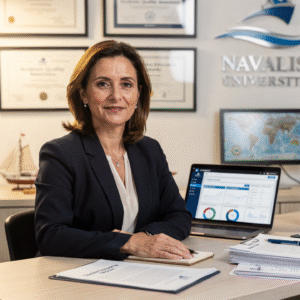 Dra. Marina AlcoverAcademic Director and Head of Quality Assurance
 Ing. Diego CifuentesSenior Lecturer in Naval Welding and Non-Destructive Testing; Head of QA/QC for Welded Joints
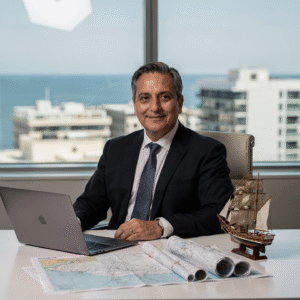 Cap. Javier Abaroa (MCA)Senior Lecturer in Ship Handling, Electronic Navigation (ECDIS/Radar/ARPA) and GMDSS; STCW Compliance and Bridge Resource Management Coordinator
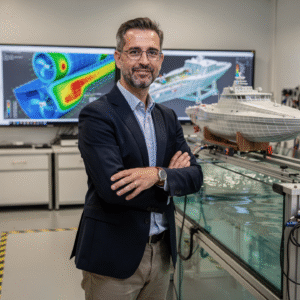 Dr. Pau FerrerSenior Lecturer in Naval Architecture and Simulation; Director of the Hydrodynamics and CFD Laboratory
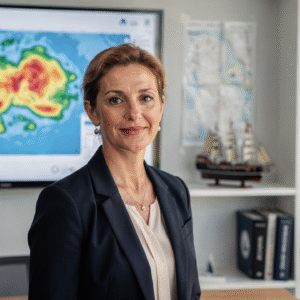 Dra. Nuria LlobregatSenior Lecturer in Marine Meteorology, SAR and Operational Safety; Navigation Risk Management Coordinator
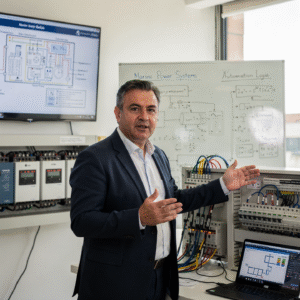 Ing. Javier BañulsSenior Lecturer in Electrical Engineering, Automation and ETO Engineering; Electronic Integration and Engine Alarms Coordinator
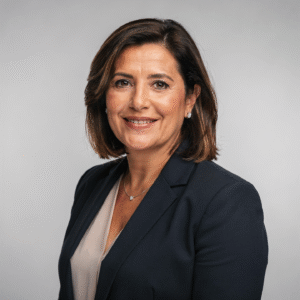 Ing. Sofía MarquinaSenior Lecturer in Materials, Composites and Corrosion Protection; Coordinator of the Advanced Paints and Coatings Line
 Ing. Tomás RieraSenior Lecturer in Propulsion, Alternative Energy and Hybrid Systems; Energy Performance and Vibration Coordinator
Objectives of the Master's in Underwater Robotics (ROVs and AUVs)
Career opportunities after the Master's in Underwater Robotics (ROVs and AUVs)
Questions about the Master's in Underwater Robotics (ROVs and AUVs)
Both ROVs and AUVs.
Yes. The pathway includes ECDIS/Radar-ARPA/BRM with port, ocean, fog, heavy-weather and SAR scenarios.
Online with live sessions; hybrid option for simulator stays/placements through partnership agreements.
An ROV (Remotely Operated Vehicle) is connected to a surface vessel by an umbilical cable that supplies power and enables communication and control, whereas an AUV (Autonomous Underwater Vehicle) operates independently with no physical connection to the surface, following a pre-programmed mission.
Functional SMCP is recommended. We provide support materials for standard phraseology.
Yes, with a related qualification or experience in maritime/port operations. The admissions interview will confirm suitability.
Optional (3–6 months) through Companies & Partnerships and the Alumni Network.
Simulator exercises (rubrics), passage plans, SOPs, checklists, micro-tests and an applied master's thesis.
More programmes in Underwater robotics
Admission process
No waiting for a call back. If your documents are in order, you can enrol in the same session.
- Academic or professional profile: aimed at students, technicians and professionals interested in the naval, maritime, port and logistics fields. Specific requirements may vary depending on the programme.
- Language: taught in English; some technical terminology and resources may appear in other languages.
- Documentation: a valid identity document and complete personal details. Depending on the level, additional academic or professional documentation may be requested.
- Technical requirements for online study: a computer with a stable internet connection, an up-to-date browser, a PDF reader and basic office software. Some programmes require specific software, as indicated in their description.
- 01ApplicationYour details, background and documents.
- 02Instant reviewWe check that everything is complete and in order.
- 03EnrolmentChoose full payment or instalments and reserve your place.
Admission is provisional until the committee validates the documents provided. If you do not meet the requirements, the full amount is refunded.
Ask us before you enrol
Leave your details and admissions will write to you to answer any questions. If you are already sure, you can apply and pay in the same session.