
Ocean Robotics Projects Course
This course immerses you in marine exploration and conservation through robotics. You will learn to design, build and program remotely operated vehicles (ROVs) and autonomous underwater vehicles (AUVs) to tackle real challenges in the ocean, from inspecting subsea infrastructure to monitoring marine life, combining theory and practice with end-to-end project planning, underwater sensors and actuators, advanced programming and project-based assessment.
Prior knowledge check
These are the skills this program gives you. Tick the ones you already master and we will tell you which part of the syllabus is for you.
You are starting from scratch in this subject. The program is designed precisely for that.
What is the Ocean Robotics Projects Course?
This short course prepares you to plan and develop robotics projects for the ocean from start to finish. You will learn how ROVs, AUVs, surface vehicles, gliders and hybrid systems differ and how to turn a mission into system requirements, how to design structures, materials, sealing and propulsion for pressure and corrosion, how navigation sensors, acoustics, sonar and cameras are fused for perception and mapping, how control, autonomy architectures and path planning make missions robust, and how to manage, test, validate and operate a robotics project safely at sea.
What sets this course apart: practical projects in which you design and test ROV and AUV solutions in simulated environments; current tools such as simulation and design software, 3D printing and marine electronics; an interdisciplinary view that brings engineering together with marine biology and oceanography; a clear understanding of the challenges and opportunities of robotics in the ocean; and an integrative project in which you design a complete system with its mission, architecture, risks and test plan.
Program highlights
- Practical projects: design and testing of ROV and AUV solutions in simulated environments.
- Current tools: simulation and design software, 3D printing and marine electronics.
- Interdisciplinary view: engineering combined with marine biology and oceanography.
- Navigation and perception: inertial sensors, acoustics, sonar, cameras and SLAM.
- Autonomy: control, mission architectures, path planning and multi-robot operations.
- Integrative project: a complete system design with mission, risks and test plan.
Syllabus of the Ocean Robotics Projects Course
5 modules. Select a module to see its content.
Fundamentals of marine robotics and mission requirements for scientific, industrial and safety operations
- 1.1. Overview of ocean platforms: ROVs, AUVs, USVs, gliders and hybrid systems by depth, endurance and payload
- 1.2. The marine environment as a design constraint: pressure, corrosion, biofouling, turbidity, salinity and energy limits
- 1.3. Mission definition: objectives, operational scenarios, success criteria, safety constraints and operating limits
- 1.4. System requirements engineering: performance, reliability, maintainability, interoperability and technical traceability
- 1.5. High-level functional architecture: subsystems, interfaces, redundancy and degraded modes for mission continuity
Mechanical design, structures, propulsion and sealing systems for subsea and surface platforms
- 2.1. Structural design for pressure and fatigue: fairings, hulls, joints, tolerances and strength criteria at depth
- 2.2. Material selection and corrosion protection: alloys, polymers, composites, coatings and galvanic compatibility
- 2.3. Sealing systems: seals, penetrators, wet and dry connectors, leak testing and mitigation strategies
- 2.4. Propulsion and maneuverability: thrusters, propellers, rudders, vector control and configuration by mission and available energy
- 2.5. Integration of actuators and payload: mountings, vibration isolation, centers of mass and buoyancy and vehicle stability
Ocean sensing, underwater navigation and environmental perception with multi-source data fusion
- 3.1. Navigation sensors: IMU, DVL, depth sensor, GNSS at the surface, compass and management of accumulated errors
- 3.2. Applied acoustics: USBL, LBL and SBL, transponders, position estimation and limits due to noise and propagation
- 3.3. Perception and mapping: multibeam and side-scan sonar, altimeter, optical and thermal cameras and real visibility conditions
- 3.4. Data fusion and state estimation: probabilistic filters, time alignment, consistency and anomaly detection
- 3.5. Map building and localization: acoustic and visual SLAM, terrain models, uncertainty and cross-validation
Control, autonomy, path planning and robotic behaviors for robust ocean missions
- 4.1. Simplified dynamic modeling: relevant degrees of freedom, current disturbances and operational compensation
- 4.2. Low-level control: stabilization, depth, heading, speed and adaptive control under changing conditions
- 4.3. Autonomy architectures: state machines, behaviors, hierarchical planning and human supervision
- 4.4. Path planning: coverage, contour following, obstacle avoidance and energy constraints
- 4.5. Multi-robot coordination and cooperative operations: task allocation, formation, synchronization and intermittent communication
Project engineering, validation at sea, operational compliance and integrative ocean robotics project
- 5.1. Integrated project management: scope, schedule, costs, procurement, suppliers and change control
- 5.2. Testing, verification and validation: V&V plans, acceptance criteria, integration tests and technical evidence
- 5.3. Operational safety at sea: risk assessment, permits, roles, communications and emergency protocols
- 5.4. Mission data management: pipeline, QA/QC, metadata, reproducibility and technical reporting for clients and authorities
- 5.5. Integrative project: complete system design covering mission, architecture, subsystems, risks, KPIs and test plan
Duration and format of the Ocean Robotics Projects Course
It is 300 hours. Tell us how many you can study each week and we will tell you when you will really finish.
This is the pace at which most students finish. It fits well with the installment plan.
Academic leadership and faculty
The Navalis teaching team: working professionals who teach and supervise the programs.
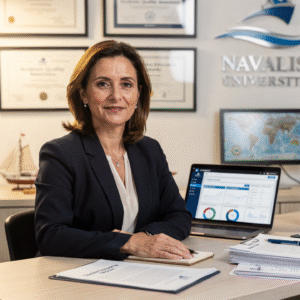 Dr. Marina AlcoverAcademic Director and Head of Quality Assurance
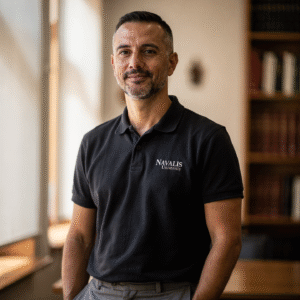 Eng. Diego CifuentesSenior Lecturer in Naval Welding and Non-Destructive Testing; Head of QA/QC for Welded Joints
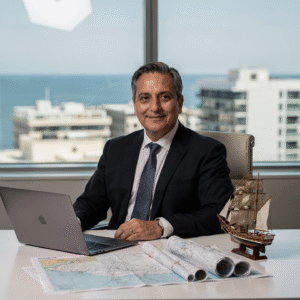 Capt. Javier Abaroa (MCA)Senior Lecturer in Ship Handling, Electronic Navigation (ECDIS/Radar/ARPA) and GMDSS; STCW Compliance and Bridge Resource Management Coordinator
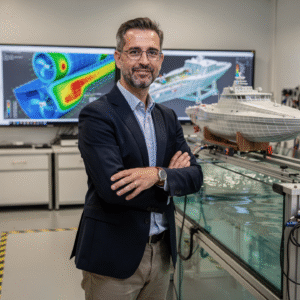 Dr. Pau FerrerSenior Lecturer in Naval Architecture and Simulation; Director of the Hydrodynamics and CFD Laboratory
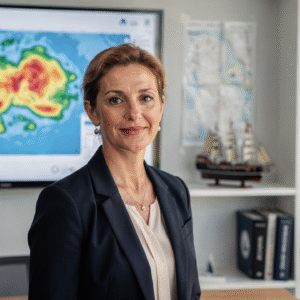 Dr. Nuria LlobregatSenior Lecturer in Marine Meteorology, SAR and Operational Safety; Navigation Risk Management Coordinator
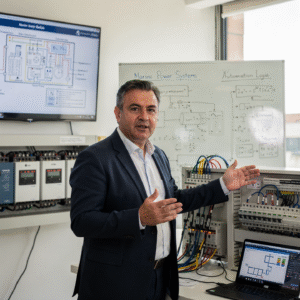 Eng. Javier BañulsSenior Lecturer in Electrical Engineering, Automation and ETO Engineering; Electronic Integration and Engine Alarms Coordinator
 Eng. Sofía MarquinaSenior Lecturer in Materials, Composites and Corrosion Protection; Coordinator of the Advanced Paints and Coatings Line
 Eng. Tomás RieraSenior Lecturer in Propulsion, Alternative Energy and Hybrid Systems; Energy Performance and Vibration Coordinator
Objectives of the Ocean Robotics Projects Course
Career opportunities after the Ocean Robotics Projects Course
Questions about the Ocean Robotics Projects Course
The ocean, from coastal waters to deep subsea environments, with surface and underwater platforms.
Pollution monitoring, inspection of subsea infrastructure, study of marine biodiversity and mapping of the seabed.
Basic knowledge of Python or C++ is recommended. Familiarity with Linux and ROS is helpful but not essential.
The course works mainly with design and simulation tools; how far you take a physical prototype depends on the resources you have available.
Through project work, culminating in an integrative project in which you design a complete ocean robotics system with its test plan.
Fully online, through a virtual campus available 24/7, with live sessions that are recorded and tutorials with the teaching staff.
The course comprises 300 hours of study across 5 modules of about 60 hours each and ends with an integrative project. You can progress at your own pace within the schedule set when you enroll.
More programs in Underwater robotics
Admission process
No waiting for a call back. If your documents are in order, you can enroll in the same session.
- Profile: aimed at engineering, oceanography and marine science students, professionals in the maritime, energy and aquaculture sectors, researchers, entrepreneurs and start-ups, and robotics enthusiasts interested in underwater technology; a degree in robotics, ocean engineering, computer engineering, marine biology or a related field, or proven experience in robotics, programming, electronics or marine fieldwork, is recommended, together with basic programming skills in Python or C++ and, ideally, familiarity with Linux and ROS.
- Language: sufficient command of English to follow the classes and the technical documentation.
- Technical resources: a computer able to run simulation and programming software, a stable internet connection, an up-to-date browser and a camera and microphone for live sessions and project presentations.
- Admission: online application, review of your profile and a short interview with the academic team.
- 01ApplicationYour details, background and documents.
- 02Instant reviewWe check that everything is complete and in order.
- 03EnrollmentChoose full payment or instalments and reserve your place.
Admission is provisional until the committee validates the documents provided. If you do not meet the requirements, the full amount is refunded.
Ask us before you enroll
Leave your details and admissions will write to you to answer any questions. If you are already sure, you can apply and pay in the same session.