
Master's in Marine Robot Swarms and Multi-Vehicle Systems
This master's prepares you to design, coordinate and operate systems of multiple marine robots that work together on the surface and underwater. You will study autonomous surface and underwater vehicles, acoustic communications and networks, cooperative navigation, distributed control, mission planning and swarm intelligence, using simulation and open-source tools, so that you can apply these emerging technologies to oceanography, inspection, safety and environmental monitoring.
Prior knowledge check
These are the skills this program gives you. Tick the ones you already master and we will tell you which part of the syllabus is for you.
You are starting from scratch in this subject. The program is designed precisely for that.
What is the Master's in Marine Robot Swarms and Multi-Vehicle Systems?
This master's prepares you to design, coordinate and operate systems of multiple marine robots that work together on the surface and underwater. You will get to know ASVs, AUVs, ROVs and gliders, apply distributed control and consensus to coordinate fleets, design networks based on acoustic communications and use task allocation and routing algorithms to plan missions, opening the door to robotics companies, technology centers and civil protection organizations.
What sets this master's apart: frontier technology in multi-vehicle coordination, a field that is evolving rapidly; a solid foundation in control, navigation and communications before you reach the swarm; realistic simulation with ROS 2 and open-source marine simulators; concrete applications in oceanography, inspection, search and surveillance; and a Final Project in which you design and simulate a multi-vehicle mission.
Program highlights
- Frontier technology: multi-vehicle coordination, a field that is evolving rapidly.
- Solid foundation: control, navigation and communications before you reach the swarm.
- Realistic simulation: work with ROS 2 and open-source marine simulators.
- Concrete applications: oceanography, inspection, search and surveillance.
- Civil focus: science, inspection, safety and the environment.
- Final Project: the design and simulation of a multi-vehicle mission.
Syllabus of the Master's in Marine Robot Swarms and Multi-Vehicle Systems
11 modules. Select a module to see its content.
Marine Robotics Fundamentals
- 1.1. History and state of marine robotics
- 1.2. Types of uncrewed marine vehicles
- 1.3. The marine environment and its constraints
- 1.4. Basic vehicle hydrodynamics
- 1.5. Propulsion and energy
- 1.6. Navigation sensors
- 1.7. Payload sensors
- 1.8. Robotic software architectures
- 1.9. Vehicle operation and recovery
- 1.10. Challenges of autonomy at sea
Surface and Underwater Vehicles
- 2.1. Autonomous surface vehicles
- 2.2. Autonomous underwater vehicles
- 2.3. Remotely operated vehicles
- 2.4. Underwater gliders
- 2.5. Hybrid vehicles
- 2.6. Dynamic modeling
- 2.7. Low-level control
- 2.8. Energy autonomy
- 2.9. Maintenance and reliability
- 2.10. Selecting platforms for each mission
Underwater Communications and Networks
- 3.1. Acoustic propagation at sea
- 3.2. Acoustic modems
- 3.3. Underwater optical communications
- 3.4. Radio and satellite at the surface
- 3.5. Underwater network protocols
- 3.6. Limited latency and bandwidth
- 3.7. Delay-tolerant networks
- 3.8. Surface-to-seabed gateways
- 3.9. Communications security
- 3.10. Designing a fleet network
Cooperative Navigation and Localization
- 4.1. Inertial navigation and DVL
- 4.2. Acoustic positioning
- 4.3. Sensor fusion and Kalman filters
- 4.4. Cooperative localization
- 4.5. Surface vehicle as a moving reference
- 4.6. Underwater SLAM
- 4.7. Multi-vehicle SLAM
- 4.8. Managing uncertainty
- 4.9. Sensor calibration
- 4.10. Assessing navigation errors
Distributed Control and Formations
- 5.1. Graph theory for multi-agent systems
- 5.2. Consensus algorithms
- 5.3. Formation control
- 5.4. Leader following
- 5.5. Collision avoidance
- 5.6. Control with intermittent communications
- 5.7. Stability of distributed systems
- 5.8. Robustness to failures
- 5.9. Distributed model predictive control
- 5.10. Implementation in simulation
Swarm Intelligence
- 6.1. Principles of swarm intelligence
- 6.2. Emergent behaviors
- 6.3. Models inspired by fish schools
- 6.4. Area coverage algorithms
- 6.5. Source seeking and localization
- 6.6. Collective decision-making
- 6.7. Scalability of swarms
- 6.8. Vehicle heterogeneity
- 6.9. Current limitations and challenges
- 6.10. State of research
Mission Planning and Task Allocation
- 7.1. Defining mission objectives
- 7.2. Route planning
- 7.3. Multi-robot task allocation
- 7.4. Auction-based algorithms
- 7.5. Optimization under energy constraints
- 7.6. Real-time replanning
- 7.7. Planning with ocean currents
- 7.8. Adaptive sampling
- 7.9. Managing long-duration missions
- 7.10. Planning tools
Perception and Data Fusion
- 8.1. Side-scan and multibeam sonar
- 8.2. Underwater vision
- 8.3. Object detection and classification
- 8.4. Fusing data from several vehicles
- 8.5. Shared maps of the environment
- 8.6. Machine learning for perception
- 8.7. Data compression for transmission
- 8.8. Mission data management
- 8.9. Data quality and validation
- 8.10. Visualizing results
Simulation, Software and Testing
- 9.1. ROS 2 for marine robotics
- 9.2. Open-source marine simulators
- 9.3. Modeling sensors and the environment
- 9.4. Simulating communications
- 9.5. Software-in-the-loop testing
- 9.6. Hardware-in-the-loop testing
- 9.7. Tank trials
- 9.8. Sea trials
- 9.9. Data logging and analysis
- 9.10. Validation methodology
Applications, Safety and Regulation
- 10.1. Oceanography and environmental observation
- 10.2. Inspection of marine infrastructure
- 10.3. Search and rescue
- 10.4. Maritime surveillance
- 10.5. Oil spill response
- 10.6. Operational safety
- 10.7. Cybersecurity of autonomous fleets
- 10.8. IMO regulatory framework for autonomous ships
- 10.9. Ethics of autonomous systems
- 10.10. Sector trends
Final Project
- 11.1. Defining the use case
- 11.2. Selecting vehicles
- 11.3. Designing the architecture
- 11.4. Designing communications
- 11.5. Navigation strategy
- 11.6. Coordination algorithms
- 11.7. Implementation in simulation
- 11.8. Evaluating results
- 11.9. Writing the project report
- 11.10. Presentation to an assessment panel
Duration and format of the Master's in Marine Robot Swarms and Multi-Vehicle Systems
It is 1,500 hours. Tell us how many you can study each week and we will tell you when you will really finish.
This is the pace at which most students finish. It fits well with the installment plan.
Academic leadership and faculty
The Navalis teaching team: working professionals who teach and supervise the programs.
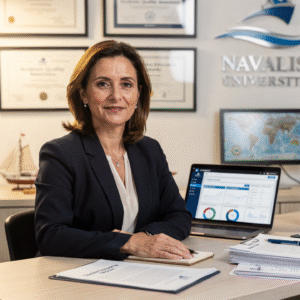 Dr. Marina AlcoverAcademic Director and Head of Quality Assurance
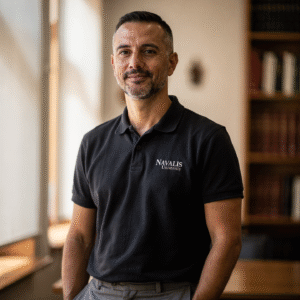 Eng. Diego CifuentesSenior Lecturer in Naval Welding and Non-Destructive Testing; Head of QA/QC for Welded Joints
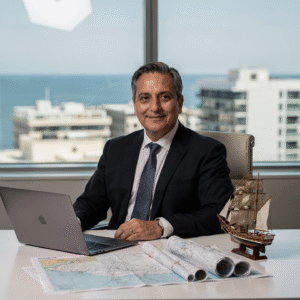 Capt. Javier Abaroa (MCA)Senior Lecturer in Ship Handling, Electronic Navigation (ECDIS/Radar/ARPA) and GMDSS; STCW Compliance and Bridge Resource Management Coordinator
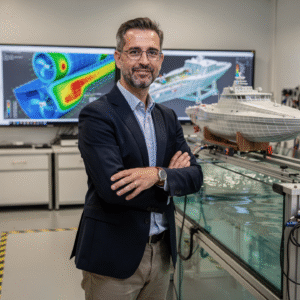 Dr. Pau FerrerSenior Lecturer in Naval Architecture and Simulation; Director of the Hydrodynamics and CFD Laboratory
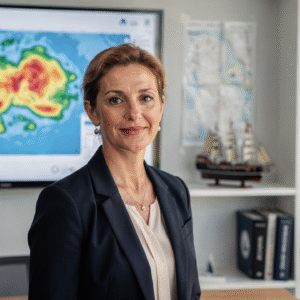 Dr. Nuria LlobregatSenior Lecturer in Marine Meteorology, SAR and Operational Safety; Navigation Risk Management Coordinator
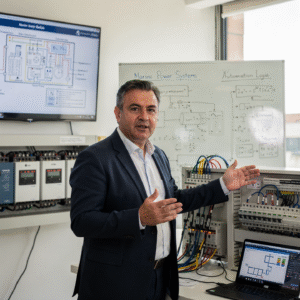 Eng. Javier BañulsSenior Lecturer in Electrical Engineering, Automation and ETO Engineering; Electronic Integration and Engine Alarms Coordinator
 Eng. Sofía MarquinaSenior Lecturer in Materials, Composites and Corrosion Protection; Coordinator of the Advanced Paints and Coatings Line
 Eng. Tomás RieraSenior Lecturer in Propulsion, Alternative Energy and Hybrid Systems; Energy Performance and Vibration Coordinator
Objectives of the Master's in Marine Robot Swarms and Multi-Vehicle Systems
Career opportunities after the Master's in Marine Robot Swarms and Multi-Vehicle Systems
Questions about the Master's in Marine Robot Swarms and Multi-Vehicle Systems
Yes, a programming background is recommended. The master's includes support in Python and ROS 2.
The main work is done in simulation; real tank and sea trials are analyzed as case studies.
Coordinated fleets are already in use, but large-scale swarms are still at research and demonstration stage.
The focus is civil: science, inspection, safety and the environment.
You design and simulate a mission with several coordinated marine vehicles.
The master's is taught entirely online, with a virtual campus available 24/7, recorded live sessions and tutorials. It comprises 1500 hours of study across 11 modules of about 136 hours each, and you progress at your own pace within the schedule you are given on enrollment.
More programs in Underwater robotics
Admission process
No waiting for a call back. If your documents are in order, you can enroll in the same session.
- Profile: aimed at telecommunications, industrial, computer or naval engineers who wish to specialize in marine robotics, graduates in physics, mathematics or marine sciences with an interest in autonomous systems, professionals at robotics and marine technology companies who develop autonomous vehicles, staff at oceanographic research centers who operate instrument fleets, and maritime security professionals who assess autonomous surveillance systems. A degree in engineering (telecommunications, industrial, computer, naval, electronic or similar), physics, mathematics or a related field, or proven professional experience in robotics or marine technology, is recommended.
- Language: sufficient command of English to follow the classes and the technical documentation.
- Technical resources: a computer with a stable internet connection, an up-to-date browser and a camera for live sessions and project presentations.
- Admission: online application, review of your profile and a short interview with the academic team.
- 01ApplicationYour details, background and documents.
- 02Instant reviewWe check that everything is complete and in order.
- 03EnrollmentChoose full payment or instalments and reserve your place.
Admission is provisional until the committee validates the documents provided. If you do not meet the requirements, the full amount is refunded.
Ask us before you enroll
Leave your details and admissions will write to you to answer any questions. If you are already sure, you can apply and pay in the same session.